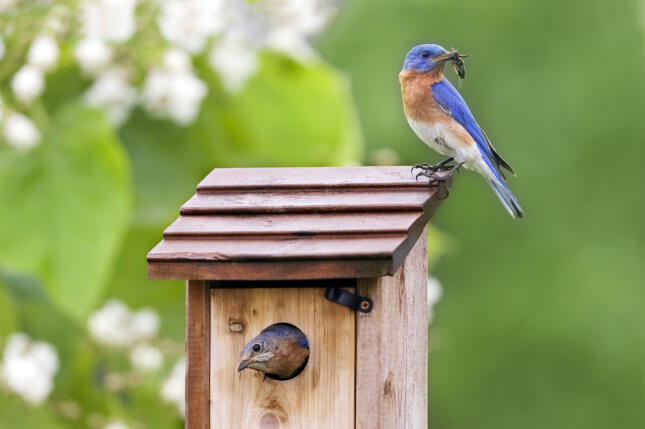
All bluebirds are cavity nesters and will use an artificial nest box. Habitat and nest cavities had been disappearing for many years, but bluebirds have made an incredible come back due to thousands of bluebird nest boxes being installed across the country.
According to the statistics from the Breeding Bird Survey, survey-wide estimates of the Eastern Bluebird population show an increase of 2.4% per year for each year since 1966. The Audubon Society’s Christmas Bird Counts from 1980 to 2004 also show a three-fold increase in population.
Bluebirds are generally monogamous, staying together throughout the breeding season, and may breed together for more than one season. However, some birds may switch mates during a breeding season to raise a second brood.
Bluebirds may raise two and sometimes three broods per season. Pairs may build their second nests on top of the first nest, or they may nest in an entirely new site. The male continues to take care of the recently fledged young while the female begins to re-nest. Young of the first brood will occasionally help raise their siblings in the second brood.
The oldest recorded Eastern Bluebird was 10 years old, with the oldest Western and Mountain Bluebird being recorded at approximately six years old.
A bluebird can spot caterpillars and insects in tall grass at the remarkable distance of over 50 yards.
Bluebirds have no blue pigments in their feathers. Instead, each feather barb has a thin layer of cells that absorb all wavelengths of color except blue. Only the blue wavelength is reflected and scattered, resulting in their blue appearance to our eyes.
Bluebirds consume about 4 grams of food per day, or about 12% of their body weight. This is equivalent to a two hundred pound human eating 24 pounds of food each day.
Eastern and Western Bluebirds sit on an elevated perch while searching for insects; when one is spotted, they drop to the ground to capture it with their bill. This sit-and-wait technique is called drop-hunting.
Unpaired male Bluebirds may sing up to 1,000 songs per hour, but average a more reasonable rate of four to five hundred songs per hour.
Bluebirds can fly at speeds up to 45 miles per hour if necessary.
When choosing natural nesting cavities, studies have shown that Eastern Bluebirds select abandoned woodpecker nests at least 75% of the time.
Eastern Bluebirds actually appear duller after molting in the late summer than at any other time of the year. Their new body feathers have dull brownish tips that wear off during the winter, leaving them bright and colorful for the next breeding season.
The first Bluebird Nesting Box Trail was established in Adams County, Illinois in 1934, by T.E. Musselman.