There are over 325 species of Hummingbirds, making them the second largest bird family in the world, second only to flycatchers. Hummingbirds are found no where else in the world except North, Central, and South America. There are 18 hummingbird species in North America.
The oldest known wild Hummingbird on recorded was a Broad-tailed Hummingbird that was over 12 years old.
Hummingbirds weigh 1/10th of an ounce; about the weight of a penny. They eat about every 10 minutes and can drink up to twice their body weight in nectar every day. One research study recorded an Anna’s Hummingbird visiting over a 1,000 flower blossoms a day.
Ruby-throated Hummingbirds have one of the highest nesting success rates of any Neotropical migrant. They usually will have two broods, each taking 45 days from nest construction to fledging.
Hummingbirds use spider webs as glue to attach the nest to a tree branch as well as a binding agent for the building materials. Their nests are about the size of a golf ball; around 1 ½ inches in diameter. Hummingbirds generally lay 2 eggs about the size of a blueberry.
Hummingbirds can extend their tongue approximately a distance equal to the length of their bill. Female Hummingbirds’ tongues are longer than the males. There is a groove on either side of the tongue that creates a capillary action to help draw the nectar up the tongue and into the mouth during the lapping action. While lapping up nectar, Hummingbirds can move their tongues in and out of their bill at a rate of up to 12 times a second.
Hummingbirds eat insects and insect eggs on the ground and in trees. They love spiders and spider eggs. They use their bill and not their tongue to catch insects.
Hummingbirds can fly up to 60 miles per hour, but typically fly at 30-45 miles per hour. Their wings beat 20-80 times per second. They can hover and are the only birds able to fly backwards and upside down. They can do this because of an extremely mobile shoulder joint.
Hummers avoid deep water, but will bathe in shallow pools or dishes, and love to take showers in sprinklers and misters. To keep their feathers in top shape, hummingbirds will leaf-bathe by fluttering against wet leaves.
During the night, Ruby-throated Hummingbirds can enter into a state of torpor to save energy. Similar to a type of short-term hibernation, torpor reduces their metabolic activity and drops their heart rate from 1,200 beats per minute to 50 beats per minute.
Hummingbirds can be very feisty and aggressive when defending their territories and will even chase away much larger birds.
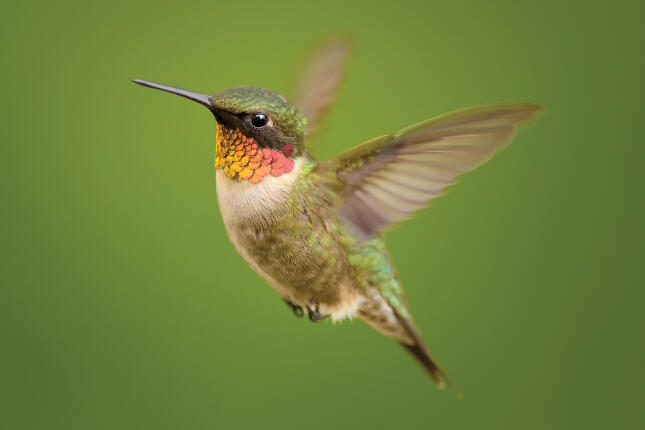
The male hummingbird’s gorget (throat patch) is iridescent and reflects certain color wavelengths. Some of these unique throat colors can be used to identify specific male species. Anna’s Hummingbird flashes neon pink; Costa’s is violet; Magnificent is green; Ruby-throated is ruby-red; and the Blue-throated is vivid blue.